


06 August 2026
Last Updated: August 6, 2026
Corporate events budgets are under scrutiny, and HR teams must prove that team building delivers measurable results. Well-designed activities genuinely shift team dynamics. At Team Building Solutions, we've spent over 30 years helping UK companies plan events that work, and success comes down to decisions made before you book a venue.
This guide covers the best team building activities for 2026, from icebreakers and indoor workshops to hybrid formats and neurodiversity-inclusive options, plus how to measure outcomes for budget conversations.
Team building in 2026 reflects three shifts: normalised hybrid work, sharper focus on inclusion, and workforce scepticism of performative activities. The trust fall is dead.
What replaces it is more interesting: structured activities mirroring real work challenges, formats that include remote participants as genuine contributors, and emphasis on psychological safety. According to CIPD's research on employee engagement and workplace culture, organisations with strong team cohesion consistently outperform those with silos, and the gap widens during organisational change.
Sustainability is now standard. Many organisations apply environmental standards to corporate away days as they do to procurement. Charity challenges, community-based activities, and zero-waste events are increasingly the default expectation from employees under 35.
The best team building activities in 2026 reflect how your team actually works, not how teams worked in 2015.
Team building icebreakers reduce social friction and increase participation before workshops or planning sessions. The best take under ten minutes, require no materials, and don't single anyone out.
Most icebreakers fail because they prioritise novelty over function. The goal is lowering the psychological cost of speaking up:
Connect icebreakers to the session's purpose. A creative workshop benefits from a different opener than a strategy day.
The strongest programmes combine formats rather than defaulting to one. Indoor activities suit precision and creativity; outdoor activities build physical trust and shared challenge; virtual activities now stand alone effectively.
Format | Best For | Group Size | Standout Feature |
|---|---|---|---|
Problem-solving, communication | 4-100 | Time pressure reveals real team dynamics | |
Collaboration, social bonding | Up to 50 | Shared meal creates lasting memory | |
Creativity, inclusion | 2-2,000 | Accessible to all abilities | |
Physical challenge, morale | 12-600+ | High energy, memorable shared experience | |
Exploration, strategy | Any | Works across cities, parks, estates | |
Remote engagement, critical thinking | Any | Story-driven, no Zoom fatigue | |
Problem-solving, digital tools | Any | Mirrors real collaborative workflows |
Escape rooms create genuine pressure in consequence-free environments. Providers like Escape Hunt UK offer immersive experiences across multiple UK venues. The format works because it strips away job titles, the person solving the puzzle isn't always the most senior, and that matters for team dynamics.
Cooking classes score consistently high for enjoyment. Le Cordon Bleu London runs hands-on culinary workshops at their Bloomsbury institute, accommodating 14-16 guests per practical class. Professional chef guidance means no prior skill is required, and the shared meal extends team cohesion beyond facilitated discussions.
Creative workshops from providers like The Crafty Hen offer sessions in mug painting, jewellery design, and notebook customisation, scaled from two to 2,000 participants. The real value is accessibility: these work for every ability level, age group, and personality type. Participants leave with something they made, extending the event's memory.
Outdoor team building introduces genuine shared physical challenge that indoor formats cannot replicate.
Dragon boat racing is the standout for high energy and clear team synergy. Providers like 12 Degrees Outdoor Team Building offer access to over 90 UK water venues, catering for groups from 12 to 600+. The activity requires every team member to paddle in synchrony, making the collaboration metaphor immediate and effective.
Tablet-led treasure hunts across cities, parks, and country estates offer flexible outdoor formats. Teams navigate using digital clues, scaling easily and incorporating company-specific content. This suits corporate away days where you want movement and exploration without requiring high physical fitness.
Charity walk challenges at 10km, half-marathon, or full-marathon distances address growing demand for sustainability-focused and socially impactful team building. Teams fundraise together, creating shared purpose that outlasts the event.
The virtual team building market matured between 2020 and 2025. The best providers now design specifically for remote participation.
Virtual murder mystery events, such as those offered by Wildgoose UK, use smartphones and Zoom with expert remote hosts guiding teams through story-driven investigations. The format encourages critical thinking and communication, with competitive elements maintaining engagement.
Remote escape rooms work similarly: teams collaborate using digital tools to solve puzzles under time pressure, mirroring real collaborative workflows closely enough to generate genuine insight into team communication.
Hybrid team building is the hardest problem in corporate events. Most organisations have solved hybrid meeting logistics; far fewer have solved hybrid connection.
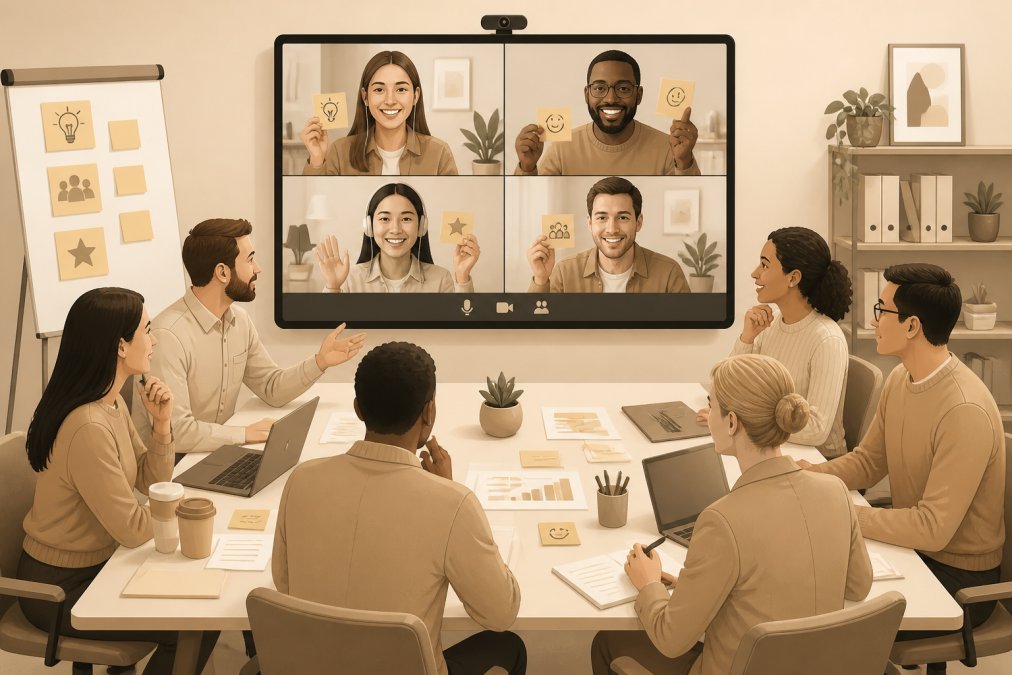
Team building ideas for hybrid teams must treat remote participants as full contributors, not observers. The most common mistake is designing in-person experiences and asking remote colleagues to watch.
Formats that genuinely work:
The logistics require more planning than purely in-person or virtual events, but the payoff is proportionally greater. Teams that successfully run hybrid events report that the experience reduces distance between office-based and remote colleagues more effectively than asynchronous communication.
According to ACAS guidance on hybrid working and team cohesion, organisations investing in structured hybrid working practices, including shared social experiences, see measurable improvements in employee retention and job satisfaction.
Inclusive team building removes unnecessary barriers to participation without removing challenge. A well-designed activity should be accessible to someone with mobility impairment, an introvert with group performance anxiety, and a neurodivergent team member who processes information differently.
Practical principles for neurodiversity-inclusive activities:
Teams where every member feels genuinely included report stronger psychological safety, the single strongest predictor of team performance identified by Google's Project Aristotle research on team effectiveness.
Corporate team building event planning determines whether the event delivers. Most problems trace back to decisions made in the planning phase.
Pre-booking checklist:
Team Building Solutions offers a free venue finding service as part of comprehensive account management, removing one of the most time-consuming elements for HR and operations teams without dedicated event resources.
Leadership will ask how to measure success. "People seemed to enjoy it" won't survive a budget review.
Team building effects are real but distributed across employee engagement scores, retention data, productivity indicators, and qualitative feedback. Define your measurement approach before the event.
Pre- and post-event pulse surveys are most practical. A short survey covering perceived team cohesion, psychological safety, and communication quality, run two weeks before and four to six weeks after, shows movement if the activity was well-designed. Keep it to five questions maximum.
Key performance indicators to track over 90 days post-event:
Indicator | What It Measures | How to Track |
|---|---|---|
Employee engagement score | Overall team morale and commitment | Quarterly engagement survey |
Cross-team collaboration frequency | Reduction in silos | Project management tool data |
Internal communication quality | Trust and openness | Manager observation, 360 feedback |
Voluntary turnover rate | Employee retention | HR system |
Absence rate | Wellbeing and morale | HR system |
Post-activity integration is the step most organisations skip, and why many programmes fail. A single event creates momentum; what happens in the four weeks afterwards determines whether that momentum converts into changed behaviour.
Practical integration steps:
According to Chartered Management Institute guidance on team performance and development, teams receiving structured follow-up after development activities retain significantly more behavioural change than those where the event stands alone.
The ROI conversation becomes easier when you can point to specific indicators that moved in the right direction. The cost of poor team cohesion, measured through turnover, absenteeism, and lost productivity, almost always exceeds the cost of a well-designed team building programme.
Building a high-performing team doesn't happen by accident, and a poorly planned event can set the process back further than doing nothing. Team Building Solutions works with HR teams, L&D managers, and operations leads across the UK to design corporate events addressing real team challenges, from post-restructure tension to hybrid workforce disconnection. With over 30 years of experience, a free venue finding service, and capacity for groups from 5 to 500, get in touch with Team Building Solutions to discuss what the right activity looks like for your team.
The biggest shifts in 2026 centre on inclusivity, hybrid-friendly formats, and measurable outcomes. Organisations are moving away from one-size-fits-all activities towards bespoke experiences that accommodate neurodiverse employees, remote workers, and mixed fitness levels. Sustainability-focused events, such as charity challenges and eco-friendly outdoor activities, are also growing in popularity. Providers that offer comprehensive account management and post-activity integration support are increasingly preferred by HR teams who need to justify spend to senior leadership.
Virtual team building activities remain firmly in demand, particularly for organisations with hybrid workforces or multiple UK office locations. The best virtual formats in 2026 go well beyond passive video calls: interactive murder mysteries, digital escape rooms, and live-hosted quiz formats all drive genuine participation. The key is choosing activities with a skilled facilitator and clear team objectives, so remote participants feel as engaged as those attending in person. Providers with dedicated remote hosting experience make a significant difference to overall team cohesion.
Start with your team's specific objective: is this about integrating new starters, rebuilding trust after a restructure, or simply boosting morale? Then factor in group size, physical accessibility, remote versus in-person split, and any neurodiversity considerations. Budget and logistics matter too, including venue, travel, and facilitation costs. A provider offering a free venue finding service and comprehensive account management can handle much of this legwork, ensuring the activity genuinely fits your team rather than forcing your team to fit the activity.
Strong team cohesion is consistently linked to higher employee engagement, and engaged employees are significantly less likely to leave. Regular, well-designed team building activities signal that an organisation invests in its people, which matters particularly during periods of restructuring or rapid growth. Activities that build real soft skills, such as communication, problem-solving, and trust, create lasting behavioural change rather than a one-day morale boost. Tracking key performance indicators like retention rates, engagement survey scores, and internal mobility before and after events helps demonstrate this value to leadership.
Small businesses do not need large budgets to run effective team building. Team building icebreakers for meetings cost nothing but a few minutes of facilitation time. Collaborative problem-solving challenges, creative workshops using simple materials, and charity volunteering days can all be organised with modest spend. For remote or hybrid teams, a well-structured virtual quiz or shared online challenge requires minimal investment. The priority is clear objectives and good facilitation, not elaborate production. A specialist provider can advise on scalable options suited to smaller groups and tighter budgets.