



09 August 2026
Last Updated: August 9, 2026
Planning a corporate team building event without a clear budget framework is a common mistake. The corporate team building budget breakdown spans fixed infrastructure costs, variable per-head expenses, and often-overlooked items like post-event evaluation and facilitator fees. At Team Building Solutions, we've helped organisations from 5 to 500 employees structure their event spend intelligently. The difference between a well-allocated budget and a poorly planned one is rarely about the total amount, it's about where the money goes.
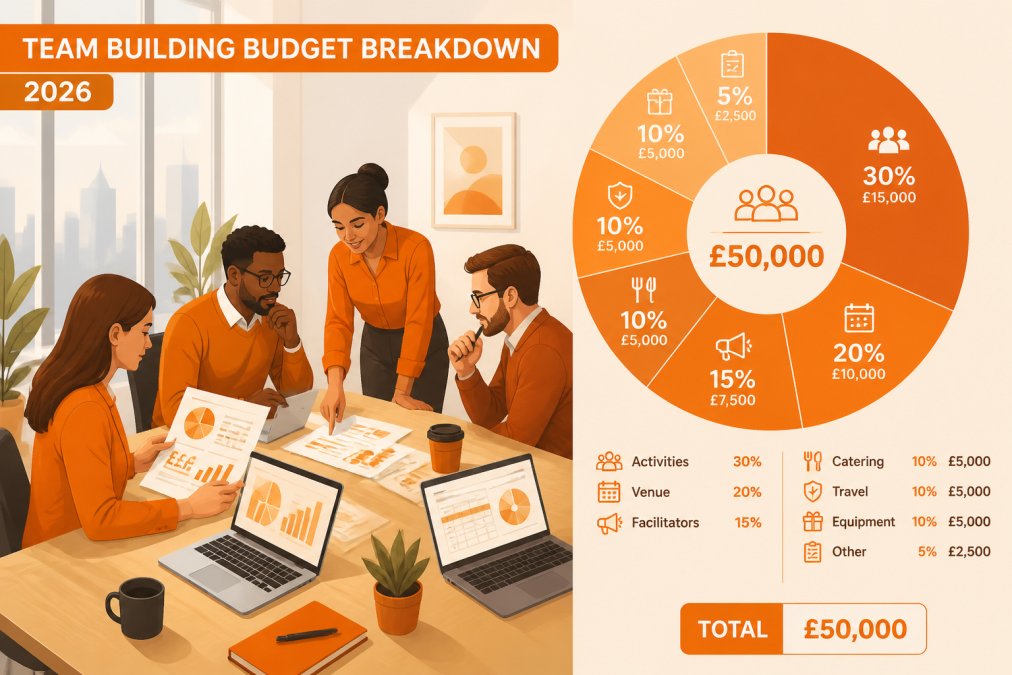
A corporate team building budget breaks into two categories: fixed costs and variable costs. Understanding both before approaching a provider means you can compare quotes accurately and identify hidden charges.
Fixed costs remain largely constant regardless of headcount. Venue hire is usually the single largest fixed line item. Off-site events at dedicated corporate retreat centres carry a room hire fee covering the space for a set number of hours. For full-day in-person workshops, venue hire represents a significant portion of the total budget, particularly in London and other major city centres.
Facilitation fees are the second major fixed cost. A professional facilitator charges for their time, expertise, and programme design. This is not a cost to cut: the quality of facilitation separates an event that genuinely shifts team dynamics from one people forget by the following Monday. According to CIPD's guidance on learning and development investment, professional facilitation is consistently cited as critical to whether L&D interventions produce lasting behavioural change.
Equipment rental completes the fixed cost picture. Depending on your chosen activities, this may include audio-visual kit, outdoor activity props, workshop materials, or specialist equipment for wellness sessions. Many providers bundle this into their facilitation fee, but confirm upfront.
Variable costs scale with employee headcount. Catering is the most predictable: per-head costs for refreshments, lunch, or evening meals add up quickly across large groups, and dietary requirements can increase unit costs. Travel expenses vary depending on whether your team is based in one location or spread across multiple offices.
Accommodation becomes relevant for multi-day corporate retreats where employees travel from different regions. Negotiate block rates with hotels near your chosen venue, or work with an event management partner who handles logistics as part of their service.
| Cost Category | Type | Scales With Headcount? | Key Variable |
|---|---|---|---|
| Venue hire | Fixed | No | Location and duration |
| Facilitation fees | Fixed | Partially | Programme complexity |
| Equipment rental | Fixed | No | Activity type |
| Catering | Variable | Yes | Dietary requirements |
| Travel expenses | Variable | Yes | Number of locations |
| Accommodation | Variable | Yes | Event duration |
| Post-event evaluation | Variable | Partially | Measurement depth |
The average cost of team building per person in the UK varies considerably based on activity type, duration, location, and whether the event is virtual, hybrid, or fully in-person. A half-day virtual quiz has a fundamentally different cost structure to a full-day outdoor corporate retreat with catering and a professional facilitator.
The market reflects a tiered structure. Budget-conscious activities with minimal facilitation and no venue hire sit at the lower end. Full-day, professionally facilitated in-person workshops at dedicated venues with catering and equipment sit at the higher end. For accurate pricing specific to your group size and requirements, request a tailored quote from a provider who can account for all your variables. Team Building Solutions offers a free venue finding service and bespoke event design, which means the per-head cost you receive reflects your actual event, not a generic estimate.
Small teams, typically under 20 people, often face a counterintuitive challenge: per-head costs can be higher because fixed costs are spread across fewer individuals. Venue hire, facilitation fees, and equipment rental do not halve when your headcount drops from 40 to 20. Small teams benefit most from providers who offer scalable packages designed for smaller groups.
Large groups benefit from economies of scale on variable costs like catering and materials. The challenge shifts to logistics: coordinating travel expenses, ensuring the venue can accommodate everyone comfortably, and maintaining engagement quality across a large audience. For groups approaching 100 or more, splitting into breakout teams with rotating activities is both practical and cost-effective.
Budget is not just about price per head: it is about matching event design to organisational objectives. A team undergoing restructuring needs something fundamentally different to a team celebrating a successful quarter, and that difference has a direct impact on the appropriate budget allocation.
The factors with the greatest influence on total event cost are:
The rise of hybrid working has permanently changed the corporate event ROI calculation. Many organisations now have a workforce split between office-based employees and remote workers, and designing a team building event that genuinely includes both groups is challenging.
In-person workshops remain the most effective format for deep team collaboration and trust-building. The shared physical experience creates connection in ways that virtual formats cannot fully replicate. However, they carry higher costs: venue hire, travel expenses, catering, and accommodation all apply.
Virtual team building events remove most overhead expenses and make it practical to include remote workers across different locations. The per-head cost is lower, but the facilitation challenge is greater: keeping participants engaged through a screen requires different expertise.
Hybrid events attempt to serve both audiences simultaneously. Done well, they are genuinely inclusive. The additional facilitation fees for a well-executed hybrid event are justified.
Tax-deductible team building activities are a legitimate way to reduce the net cost of your annual event spend. According to HMRC's guidance on staff entertaining and benefits, the annual staff party exemption allows employers to provide social functions for employees up to a set threshold per head per tax year without triggering a taxable benefit. This exemption applies to annual events open to all employees, which most professionally organised team building days satisfy.
The key conditions under HMRC rules are that the event must be open to all employees (or all employees at a particular location), it must be an annual event, and the total cost per head must not exceed the current threshold. If the cost exceeds the threshold, the full amount becomes a taxable benefit. For current figures, check HMRC's Employment Income Manual directly, as thresholds are subject to change.
For events that fall outside the annual party exemption, such as ad hoc team workshops or leadership development days, costs may still be deductible as a business expense, provided they are wholly and exclusively for business purposes. Confirm the tax treatment with your accountant before finalising the budget.
Duration is one of the most direct levers on total event cost: longer events require more facilitation time, more catering, and often accommodation.
| Event Format | Typical Duration | Best For | Budget Implication |
|---|---|---|---|
| Ice-breaker session | 1-2 hours | New team introductions | Lowest cost |
| Half-day workshop | 3-4 hours | Focused skill-building | Moderate |
| Full-day event | 6-8 hours | Deep team collaboration | Higher investment |
| Multi-day retreat | 2-3 days | Strategic alignment or restructuring | Highest cost |
| Virtual session | 1-3 hours | Remote-first or hybrid teams | Cost-effective |
The most common mistake is choosing a duration based on what feels manageable rather than what the objective requires. A 90-minute session will not resolve genuine interdepartmental tension. A three-day retreat is not necessary for a team that simply needs a morale boost. Matching duration to objective is what makes the spend defensible internally.
For teams undergoing restructuring or merger integration, a full-day or multi-day format gives facilitators enough time to work through real dynamics. For employee engagement maintenance, shorter, more frequent sessions often deliver better outcomes than one large annual event.
Corporate event ROI measurement separates organisations that treat team building as a cost from those that treat it as an investment. Measuring the return on an employee engagement event is harder than measuring marketing ROI, but it is not impossible.

The most credible approach combines pre- and post-event measurement across meaningful indicators. According to Chartered Institute of Personnel and Development research on employee engagement, organisations with high employee engagement consistently outperform those with low engagement on productivity, retention, and absence metrics. The event itself is a specific intervention within a broader engagement strategy.
Post-event evaluation is one of the most consistently underbudgeted items in a corporate team building budget breakdown. Most organisations spend nothing on it, which means they have no data to justify the next event.
A basic post-event evaluation framework costs relatively little to implement:
The cost of this evaluation is primarily time. If you use a specialist provider, ask whether post-event reporting is included in their account management service.
Annual HR budget allocation for team building is rarely approached with a consistent methodology. A more defensible approach links the team building budget to specific employee engagement objectives within the annual people strategy.
Organisations prioritising workplace culture and employee retention as competitive advantages typically allocate more to team building. Those in cost-reduction cycles typically allocate less, though this is often a false economy: the cost of replacing an employee who leaves due to poor team morale is substantially higher than the cost of a well-designed team building programme.
For practical budget optimisation, consider the following allocation principles:
Team Building Solutions handles the full scope of event planning and logistics, from initial brief to post-event reporting, for groups of 5 to 500. Get in touch with the team | contact or make a booking | booking directly to receive a tailored proposal.
Getting the corporate team building budget breakdown right requires more than a per-head cost estimate. It requires a clear view of fixed and variable costs, an understanding of HMRC's rules on staff entertaining, a measurement framework that justifies the spend to leadership, and a provider with the experience to deliver against your specific objectives. Team Building Solutions brings extensive experience to this process, with a free venue finding service, award-winning wellness sessions, and comprehensive account management that removes the planning burden from your team. Contact Team Building Solutions | contact to discuss your requirements and receive a proposal built around your budget and goals.
Per-head costs vary considerably depending on activity type, group size, venue choice, and whether the event is virtual or in-person. Half-day workshops generally cost less per person than full-day off-site corporate retreats that include catering and accommodation. Because pricing depends on your specific employee headcount, location, and requirements, the most reliable approach is to request a tailored quote. Team Building Solutions can provide a detailed breakdown based on your group size and objectives.
The primary cost components in any corporate team building budget breakdown include venue hire, facilitation fees, catering, travel expenses, equipment rental, and any accommodation for off-site events. Variable costs such as group size, activity duration, and bespoke programme design also affect the total. Post-event evaluation and follow-up materials are often overlooked overhead expenses worth including in your fiscal planning from the outset.
HMRC allows businesses to claim tax relief on team building expenditure when the event qualifies as a business expense. Staff entertainment falls under the annual staff party exemption, currently set at £150 per head per tax year, provided the event is open to all employees. Costs beyond this threshold, or events restricted to select staff, may attract a benefit-in-kind liability. Always consult a qualified accountant or tax adviser to confirm your specific circumstances before filing.
Justifying your team building budget to leadership requires linking activity spend to measurable outcomes: employee retention rates, engagement survey scores, productivity metrics, and sickness absence data. Establishing a pre-event baseline and measuring the same indicators three to six months post-event gives you concrete figures. Team Building Solutions can support this process by helping you define objectives upfront, so the corporate event ROI measurement is built into the programme from day one.