

11 August 2026
Last Updated: August 11, 2026
Inclusive corporate team building activities are essential for building workforces where every employee feels valued and engaged. The challenge isn't finding activities; it's designing experiences where someone with mobility limitations feels equally invested as their able-bodied colleagues, where introverts thrive alongside extroverts, and where neurodivergent team members aren't forced into uncomfortable social scripts.
At Team Building Solutions, we've spent over 30 years designing events that work for groups of 5 to 500 people. Truly inclusive corporate team building activities don't accommodate difference as an afterthought; they're built around it from the start. That means offering physical and mental pathways to participation, not just ticking a box with "optional activities."
According to workplace engagement studies from the Chartered Institute of Personnel and Development, organisations that prioritise inclusive team building see measurable improvements in employee retention and cross-departmental collaboration. Below, we'll show you exactly how to design inclusive corporate team building activities that work across abilities, locations, and personality types.
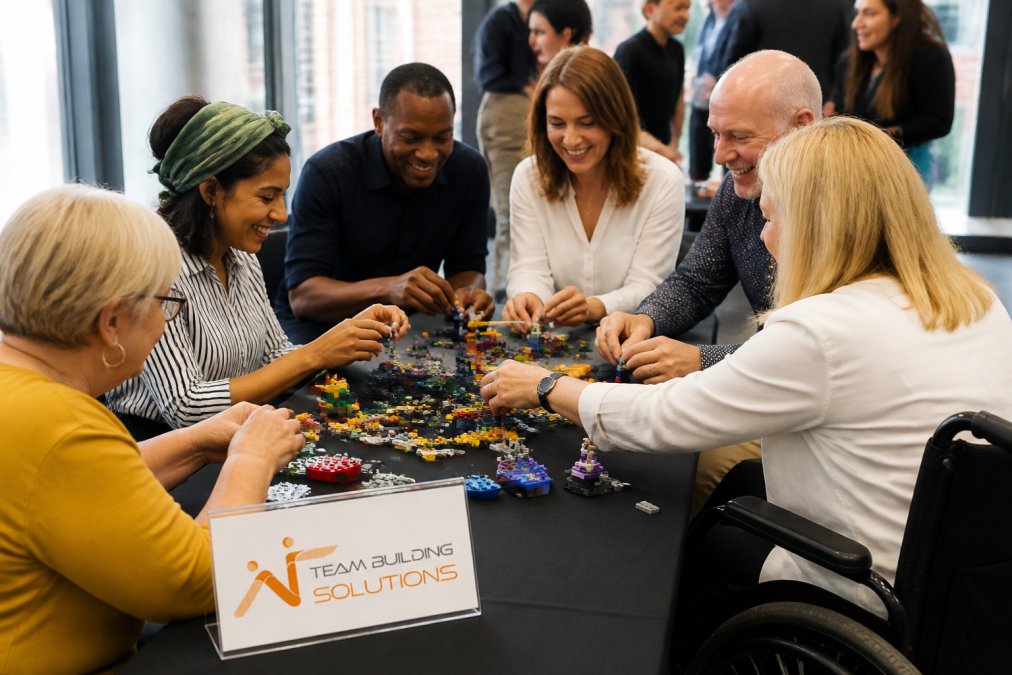
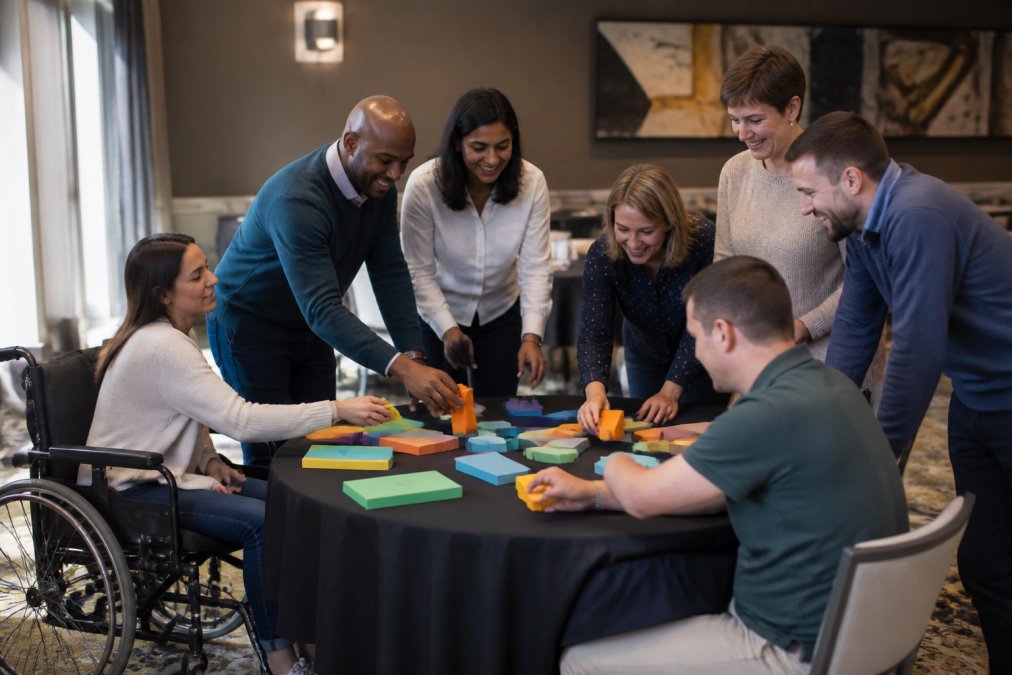
Indoor team building offers a controlled environment where accessibility features can be built in from the start. The best indoor activities allow people to contribute in different ways, through thinking, leading, creating, or supporting, rather than demanding uniform physical participation.
Quiz-based competitions level the playing field in ways that high-energy activities cannot. Quiz competitions transform traditional trivia into a professional game show experience with customisable difficulty levels, allowing you to pitch questions to suit your actual team's knowledge.
What makes this approach genuinely inclusive is the flexibility. You can adjust question themes to reflect your company's culture, set difficulty levels that challenge without humiliating, and allow teams to include quieter members who might shine in a structured knowledge-sharing format. For neurodivergent team members, the clear rules and predictable structure often work better than open-ended social activities. For people with mobility challenges, the seated format removes barriers entirely.
Diversity-focused charades shift the purpose from entertainment to genuine conversation. Rather than guessing random films, teams act out concepts related to identity, culture, and inclusion, creating space for meaningful dialogue.
This format works for mixed ability groups. You don't need physical strength or high energy, you need creativity and willingness to participate. Some team members will perform elaborate acts; others will offer one-word clues. Both contributions matter equally.
Outdoor team building doesn't have to mean hiking or obstacle courses. The key is flexibility: offering multiple ways to participate in the same activity.
GPS treasure hunts use technology to guide teams through exploration and problem-solving without requiring a specific fitness level. Teams navigate using GPS clues, solve puzzles at waypoints, and work collaboratively to reach checkpoints, with routes adapted to individual needs.
What makes this inclusive is the flexibility built in. If someone has mobility limitations, they can navigate by vehicle or take a shorter route to the same checkpoint. If someone has sensory sensitivities, you can adjust the number of stops or challenge types. The competitive element remains, but the playing field is genuinely level.
A corporate away day that truly works for everyone combines multiple activity types in a single event. You might run a morning GPS hunt for those who want outdoor movement, a simultaneous quiz competition for those who prefer mental challenges, and a creative workshop for those seeking collaborative problem-solving without physical or competitive elements.
Team Building Solutions designs corporate away days with this mixed-activity approach as standard. The free venue finding service means you can choose a location with indoor and outdoor spaces, accessible facilities, and room for different activities to run in parallel.
Remote and hybrid teams face a unique challenge: building cohesion when people aren't in the same room. Effective virtual activities are designed specifically for remote participation, not adapted from in-person formats.

Virtual escape rooms work because they're built around the constraints of remote participation. Teams are split into breakout rooms, given a shared puzzle interface, and work together to solve clues within a time limit. The format forces communication and creates genuine collaboration.
What makes this inclusive is accessibility. There's no travel required, no physical demands, and no sensory overload from a crowded venue. Team members can participate from home in a quiet environment that suits them. Puzzles can be adjusted for difficulty, and teams can include people with different cognitive strengths.
Virtual cocktail making takes the pressure off forced socialising. Rather than sitting in a video call trying to make small talk, team members learn a practical skill together while naturally chatting. Ingredient kits are sent in advance, and a professional mixologist leads the session.
For remote workers, this creates a genuine social moment without awkwardness. People are learning something, creating something, and sharing a moment together. The informality often leads to more authentic connection than structured icebreakers.
Neurodivergent team members often experience standard team building as exhausting or alienating. Loud, unstructured activities and unexpected social demands can leave them drained rather than connected.
Accessible team building ideas for neurodiversity start with predictability. Clear agendas, defined roles, and structured activities work better than open-ended socialising. The practical approach: offer a menu of activities and let people choose. Include quiet spaces where people can take breaks. Provide agendas in advance. Use written instructions alongside verbal ones.
For mobility accessibility, the physical environment matters enormously. Accessible parking, level entrances, accessible toilets, and seating options throughout activities aren't luxuries, they're necessities. A venue with these features signals that everyone is genuinely welcome.
Inclusive corporate team building activities rest on several foundations. First, involvement. If you're designing team building for a diverse group, involve diverse people in the design. Ask neurodivergent team members what activities would work for them. Ask people with mobility challenges about accessibility needs.
Second, choice. The most inclusive events don't mandate universal participation in a single activity. They create a schedule where people can choose activities that suit them, then come together for shared meals and reflection.
Third, clear communication. Provide detailed information about each activity in advance: what it involves, how long it lasts, what the physical or sensory demands are, and what accommodations are available.
Fourth, facilitation. Good facilitation makes the difference between an activity that connects and one that alienates. A skilled facilitator can redirect awkwardness, ensure quieter voices are heard, and manage group dynamics.
Finally, measurement. Track retention rates, cross-departmental collaboration, psychological safety scores, and whether people are more likely to speak up in meetings. Research from the Institute for Corporate Productivity shows that inclusive team experiences correlate with measurable improvements in team performance and employee wellbeing.
Facilitation is where inclusive corporate team building activities either succeed or or fail. A well-facilitated workshop creates psychological safety, the sense that people can be themselves without fear of judgment or exclusion.
Start with clear objectives. What are you actually trying to achieve? Improved communication? Cross-departmental understanding? Stress relief? Once you know the goal, design activities that genuinely serve that goal.
During the activity, a good facilitator manages group dynamics actively. They ensure quieter voices are heard, redirect conversations that veer into uncomfortable territory, and create space for people to participate at their comfort level.
For measurement, move beyond satisfaction surveys. Also measure outcomes that matter: Did cross-departmental collaboration improve? Are people more likely to speak up in meetings? Did retention improve? Did psychological safety scores increase?
Team Building Solutions includes measurement as part of comprehensive account management.
Inclusive corporate team building activities aren't a separate category; they're what good team building looks like. When you design for neurodiversity, mobility differences, introversion, and diverse personality types, you create experiences that work better for everyone.
The difference between generic team building and genuinely inclusive events comes down to intentionality: choosing activities that offer multiple pathways to participation, communicating clearly about what's involved, involving diverse voices in the design, and measuring outcomes that matter.
Team Building Solutions brings over 30 years of experience designing bespoke corporate events that work for groups of 5 to 500 people. Our award-winning wellness sessions, mixed-activity formats, and comprehensive account management, including free venue finding, ensure every detail of your corporate away days is handled with reliability and genuine attention to inclusion. Contact Team Building Solutions to discuss your next event or book a consultation about your team building needs.
Truly inclusive team building activities offer multiple ways to participate, accommodate different physical abilities and neurodiversity, and avoid putting anyone in an uncomfortable spotlight. Activities should have low-pressure options, allow for quiet participation, provide clear instructions, and respect cultural and personal boundaries. The best inclusive corporate team building activities let introverts contribute meaningfully without forced public performance, offer physical and mental challenge options, and ensure everyone leaves feeling valued rather than excluded.
Choose activities with flexible participation options: indoor venues with wheelchair access, seated alternatives to standing challenges, and virtual attendance options for those unable to travel. Communicate accessibility needs in advance, provide detailed venue information, and offer activities that don't require physical exertion as a core component. Quiz-based competitions, virtual escape rooms, and facilitated workshops can engage participants regardless of mobility. Always ask team members about access requirements beforehand rather than assuming needs.
Introverts and neurodiverse team members often thrive in structured, smaller-group activities with clear roles. Consider escape room challenges where problem-solving happens in small teams, quiz competitions where expertise is valued, or skill-based workshops. Avoid activities requiring spontaneous public speaking or prolonged eye contact. Offer opt-in rather than mandatory participation, provide quiet spaces during events, and allow people to work in pairs rather than large groups. Virtual options also reduce sensory overload for some participants.
Measure impact through employee engagement surveys before and after events, track retention rates among participants, monitor internal collaboration metrics, and gather qualitative feedback on team cohesion. Post-event surveys should ask about comfort levels, sense of belonging, and willingness to collaborate across departments. Some organisations track sick leave reduction and productivity changes. Document how the activity addressed specific team challenges, such as cross-departmental tension or remote worker isolation, to demonstrate tangible business value beyond morale.