



14 August 2026
Last Updated: August 14, 2026
A corporate team building budget is the total financial allocation your organisation dedicates to designing, planning, and executing team engagement activities aimed at strengthening relationships, improving communication, and fostering workplace culture. This investment typically encompasses everything from venue hire and facilitator fees to catering, activities, and contingency reserves.
Getting your corporate team building budget right matters because it directly affects what you can deliver. Underfund it and you're stuck with generic activities that feel obligatory. Overspend without a clear framework and you'll struggle to justify the investment to leadership. The sweet spot sits between realistic cost planning and measurable business outcomes.
According to CIPD research on employee engagement, organisations that invest strategically in team cohesion report higher retention rates and improved collaboration. At Team Building Solutions, we've found that the best approach starts with understanding what actually costs money, then working backwards from your business objectives. This guide walks you through the real expenses, hidden costs, and financial frameworks that separate effective team building investments from wasted budget.
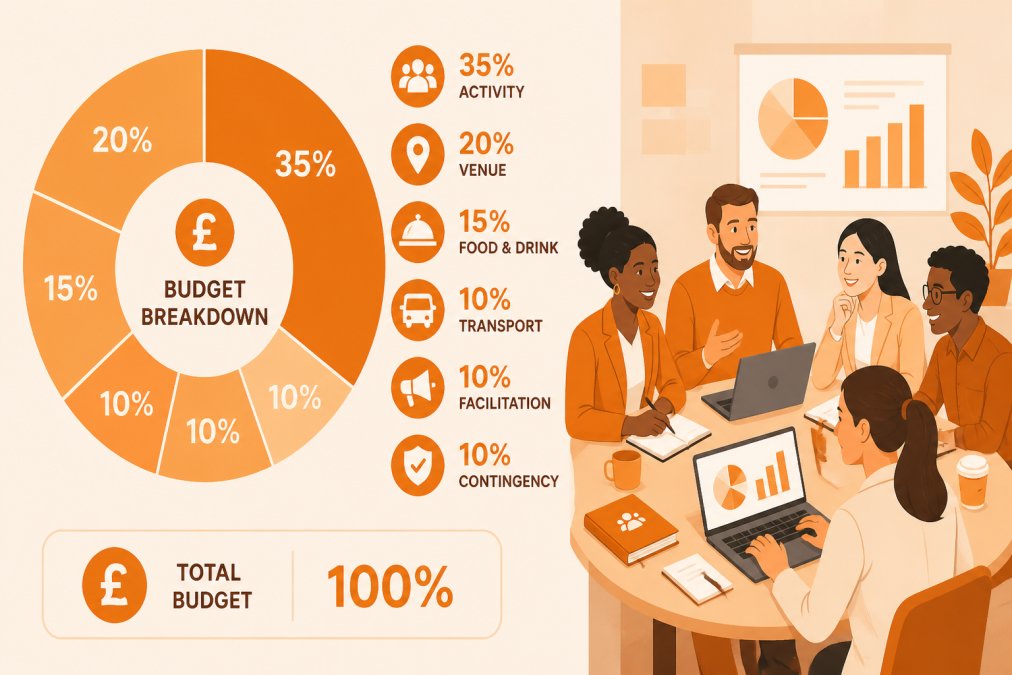
Your corporate team building budget splits into five main categories. Understanding each one prevents the common mistake of underestimating costs or being blindsided by unexpected expenses halfway through planning.
Venue costs typically represent 25-40% of your total budget, depending on group size and location. This includes the space rental itself, parking, equipment setup, and access arrangements.
The venue choice directly impacts what activities you can run. An outdoor activity requires weatherproof facilities and backup indoor space. A virtual event needs reliable video conferencing infrastructure. A hybrid setup, where some teams attend in-person whilst others join remotely, adds complexity and cost.
Logistics costs include transport for staff (especially if attendees travel from multiple office locations), equipment hire (tables, chairs, AV equipment, microphones), and setup/breakdown labour. For larger events, you'll also budget for insurance and venue coordinator fees.
Team Building Solutions manages venue logistics as part of our comprehensive account management, including our free venue finding service, so your internal team focuses on business outcomes rather than logistical coordination.
Trained facilitators design and lead your team building activities. A skilled facilitator reads the room, adjusts pacing, includes quieter team members, and ensures activities align with your actual business objectives.
Facilitation costs depend on event duration, group size, and activity complexity. A half-day workshop with structured icebreakers costs less than a full-day event with custom-designed activities tailored to your team's specific challenges. Additional staffing might include event coordinators on the day, registration staff, or technical support for remote or hybrid events.
Food and beverages typically run 15-25% of your budget. This includes breakfast (if starting early), lunch, afternoon snacks, and beverages throughout the day.
The cost per head varies significantly based on catering quality and dietary requirements. Many teams now factor in vegan, gluten-free, and allergen-aware options, which increases catering complexity and cost. Hungry teams disengage, so quality matters.
This is where most budgets go wrong. Teams account for obvious costs but miss the smaller items that add up quickly.
Hidden expenses include contingency funds for last-minute changes (typically 10-15% of total budget), printing costs for materials and name badges, childcare support or travel subsidies, accessibility accommodations, post-event evaluation tools, thank-you gifts or branded merchandise, insurance, and cancellation fees if you need to reschedule.
Team building cost per head is your total budget divided by the number of attendees. This metric helps you benchmark your investment and compare different event options fairly.
To calculate it: Total Budget ÷ Number of Attendees = Cost Per Head
For example, a £5,000 event for 50 people equals £100 per head. A £8,000 event for 100 people equals £80 per head. The second option delivers more people for less per-person investment, but that doesn't automatically make it better. Smaller, more intimate events sometimes deliver stronger outcomes than large generic ones.
Cost per head varies by event type:
Not every team building investment requires a large budget. Many effective activities cost little but require thoughtful design and clear facilitation.
Internal knowledge-sharing sessions bring team members together to teach one another about their work. A marketing specialist explains campaign strategy to operations staff. The finance team walks through budget processes. Cost: minimal (just staff time). Value: builds cross-functional understanding and breaks down silos.
Structured problem-solving workshops tackle real business challenges as a team. Rather than generic trust falls, teams work together on something that matters to the organisation. This builds both cohesion and delivers tangible business outcomes.
Virtual team building for distributed teams works well for organisations with remote or hybrid setups. Online games, virtual escape rooms, or guided wellness sessions keep costs low whilst including everyone regardless of location.
Outdoor activities and sports days appeal to teams that prefer physical engagement. Walking groups, cycling events, or team sports require minimal investment if you use local parks and volunteer coordination.
Wellness-focused sessions like yoga, meditation, and stress management appeal to teams seeking balance rather than high-energy activities. These often cost less than elaborate events and genuinely improve wellbeing.
The common thread: low cost doesn't mean low value. It means intentional design, clear objectives, and genuine relevance to your team's actual needs.
How long your team building event lasts directly affects both costs and outcomes.
Half-day events (3-4 hours) work well for teams that can't afford full-day absence from work. They're cost-effective but limit depth. Full-day events (6-8 hours) allow proper activity sequencing and relationship building, delivering more impact. Multi-day away days create the strongest team cohesion but require the largest budget for travel, accommodation, meals, and extended facilitation. Shorter virtual sessions (45-90 minutes) suit distributed teams with minimal cost, though effectiveness drops if sessions are too frequent.
The relationship between duration and cost isn't linear. A full-day event doesn't cost twice as much as a half-day one; it might cost 40-50% more because some expenses are fixed regardless of duration.
Team building ROI measurement proves that your investment delivered tangible business value. This is what separates strategic team building from feel-good spending.
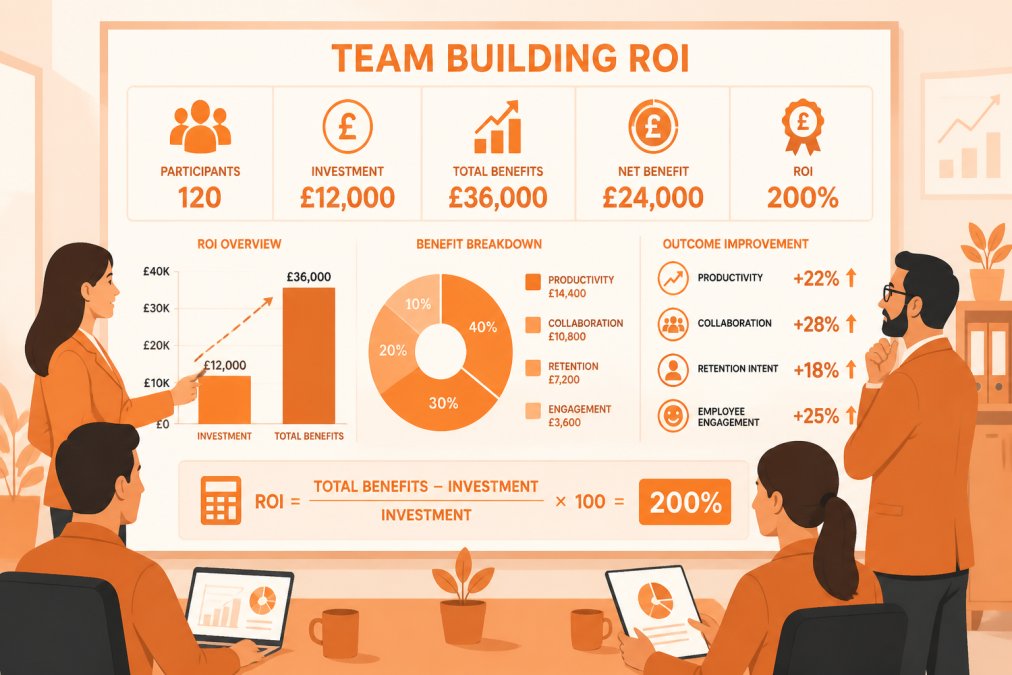
Most organisations struggle here because team building outcomes feel intangible. However, you can measure the business indicators that team building influences.
Employee retention rates are the strongest ROI indicator. Teams with strong cohesion stay longer. Track retention rates before and after your investment. If turnover drops by even 5%, the cost savings often exceed the event investment within 12 months.
Absenteeism and sick leave decline when teams feel genuinely connected. Internal mobility and promotion rates improve when teams collaborate effectively. Project completion rates and delivery timelines improve when team communication strengthens. Employee engagement survey scores should improve measurably after team building investment.
The key: measure something specific before the event, then measure it again 4-8 weeks later. Focus on business outcomes that matter to your leadership.
Your team's work setup dramatically changes how you budget for team building.
In-person events for co-located teams have predictable costs. You book a venue, arrange catering, hire facilitators, and go. Remote team building shifts your budget from venue and catering to technology, online facilitation, and engagement tools. Costs typically drop significantly. Hybrid events, where some teams attend in-person whilst others join remotely, present the biggest budgeting challenge. You need venue space, catering, and facilitators for the in-person group, plus reliable video conferencing and technical support for remote participants.
Hybrid events require intentional design. Remote participants can't just watch the in-person event on a screen. Instead, structure activities that genuinely include both groups through breakout rooms with mixed participants and facilitation that explicitly brings remote voices into discussions.
Team Building Solutions has extensive experience designing events that work across in-person, remote, and hybrid setups. Our comprehensive account management ensures your event delivers genuine connection and measurable outcomes regardless of your team's setup.
Budget allocation differs by setup:
Team building events can qualify for tax relief under specific conditions, which affects your net budget cost. Understanding the rules prevents overpaying tax and ensures your organisation maximises the business case.
According to HMRC guidance on employee benefits, team building activities can be treated as exempt benefits if they meet certain criteria. The key requirement: the event must be available to all employees (or a substantial group), and it must not be primarily a reward for individual performance.
Qualifying events typically include annual team away days or conferences, wellness and wellbeing activities, professional development workshops with a team building component, and celebration events for company milestones. The annual exemption allows one qualifying event per employee per year without triggering a taxable benefit.
Non-qualifying events that trigger tax liability include reward trips for individual performance, events that aren't open to all employees, and activities that primarily benefit specific individuals.
If your event doesn't meet qualifying criteria, the cost becomes a taxable benefit to employees. This doesn't prevent the event, it just means employees pay tax on the benefit value.
Team building investment isn't about throwing a party, it's about strengthening the foundation of how your team works together. The most effective corporate team building budgets balance cost control with genuine impact, measure outcomes that matter to your business, and adapt to how your team actually works.
Team Building Solutions specialises in designing bespoke corporate events that deliver measurable outcomes for groups ranging from 5 to 500 guests. Our team manages every detail, from free venue finding to comprehensive facilitation, so your budget translates into genuine team cohesion and business impact. Contact us to discuss your team building budget or explore our booking options to see how we can help you maximise your investment.
The appropriate spend depends on your business objectives, team size, and event scope. Organisations typically allocate between £20 and £150 per head for half-day activities, rising to £100-300+ per person for full-day or overnight events. Your corporate team building budget should reflect what outcomes matter most: improved team cohesion, skill development, or cultural alignment. Team Building Solutions can help you determine the right investment level for your specific goals and team dynamics.
Several key factors affect pricing: team size, venue location and hire costs, activity type and facilitator fees, event duration, catering requirements, and logistics (transport, accommodation for away days). Hidden expenses like contingency funds, insurance, and equipment rental also add up. For hybrid or remote teams, technology costs increase. The more tailored and bespoke your event, the higher the investment. Team Building Solutions manages these variables transparently to help you allocate your budget effectively.
Effective low-cost alternatives include structured problem-solving challenges, outdoor team walks with facilitated discussion, virtual collaborative games for remote teams, and skills-swap workshops where employees teach each other. Ice-breaker activities designed around your business objectives, rather than generic trust falls, build genuine team cohesion without inflated costs. The key is intentional activity planning that aligns with your workplace culture and team dynamics. Duration and facilitator quality matter more than expense; a well-designed two-hour session often delivers better morale and employee engagement than an expensive but poorly structured day.
Frame the investment around measurable business outcomes: improved employee retention, reduced absenteeism, faster onboarding of merged teams, or increased productivity. Document baseline metrics before the event, engagement scores, turnover rates, project completion times, then measure the same metrics 3-6 months after. Highlight tax-deductible status under HMRC rules for training and employee development. Present ROI data from similar organisations, and explain how team cohesion directly reduces hiring and training costs. Team Building Solutions can provide evaluation frameworks and post-event reporting to demonstrate concrete return on investment to your leadership team.
Yes, many corporate team building expenses qualify as tax-deductible under HMRC guidelines, provided they're classified as employee development or training rather than pure entertainment. Venue hire, facilitator fees, and activity costs for events designed to improve team dynamics and workplace skills generally qualify. Catering costs may be partially deductible if the event is primarily business-focused. Alcohol and luxury items face stricter rules. To ensure compliance, document the business purpose clearly and consult your accountant. Team Building Solutions events are structured to meet HMRC standards, helping you maximise tax efficiency while investing in genuine employee engagement.
Remote team events require investment in technology platforms, video facilitation expertise, and engagement tools to prevent Zoom fatigue, costs that in-person venues don't incur. Hybrid events demand both physical and virtual infrastructure, doubling complexity and often cost. Remote teams benefit from shorter activity durations (90 minutes to 2 hours) with lower per-head costs but higher production quality. In-person events allow longer sessions and more dynamic activities. Budget 15-25% more for hybrid events to cover dual logistics. Team Building Solutions specialises in seamless hybrid delivery, ensuring remote and office-based staff feel equally included without inflating your overall budget.
Establish metrics before the event: employee engagement scores, team cohesion ratings, voluntary turnover, project completion times, and internal collaboration indicators. Use post-event surveys (within 2 weeks) and follow-up assessments at 3 and 6 months. Compare pre- and post-event data to quantify impact. Track soft metrics like improved communication and reduced conflict alongside hard metrics like productivity gains. Calculate ROI by dividing measurable financial gains (reduced turnover costs, productivity improvements) by total event spend. Team Building Solutions provides post-event evaluation frameworks and detailed reporting to help you prove business impact and justify future investment in team building activities.