


15 August 2026
Last Updated: August 15, 2026
Modern organisations face a genuine challenge: distributed workforces create friction. Remote employees report lower connection to colleagues, whilst on-site staff sometimes feel overlooked in virtual-first communication. The solution isn't choosing between in-person and virtual experiences, it's building hybrid team building activity ideas that bring both groups together meaningfully.
At Team Building Solutions, we've spent over 30 years designing events for organisations ranging from five to 500 people. The best activities aren't the flashiest; they're the ones where every participant, regardless of location, feels genuinely included and valued. This guide covers 15 proven hybrid team building activity ideas, implementation details that matter, and how to measure whether your investment in team connection is paying off.

Virtual escape rooms require genuine collaboration without relying on physical proximity. In-office teams gather around a shared screen whilst remote participants join via video call, solving puzzles together in real time. The ticking clock and shared objective naturally break down awkwardness that accompanies forced team bonding.
Remote and on-site staff contribute equally to solving clues, there's no "watching" involved. A person working from home might spot a pattern in a cipher just as easily as someone in the office. Choose providers that design puzzles for mixed-location teams, not ones adapted from in-person experiences.
Trivia works at scale because the format is inherently inclusive. Run trivia in rounds with small teams (4-6 people per team, mixed remote and on-site). Each round focuses on a different category: company history, industry knowledge, pop culture. The real value emerges in the banter between rounds, where remote employees gain recognition for their contributions.
These activities ask teams to solve a real problem together in 30-45 minutes. The constraint forces real-time communication, remote and on-site staff can't rely on async email exchanges. They must think together, challenge each other's ideas, and build on them in the moment.
Divide into mixed teams of 5-7 people. Use a shared digital whiteboard so everyone can see ideas being sketched in real time. Each team presents their solution in two minutes at the end.
Effective ice-breakers are specific, not generic. Games where people share unusual skills, worst job interview stories, or controversial industry opinions naturally generate genuine interaction. Use breakout rooms to split the larger group into clusters of 6-8 people, mixing remote and on-site staff. Run the same ice-breaker in each room simultaneously for 15-20 minutes.
Scavenger hunts work brilliantly for hybrid teams because they accommodate different locations equally. Remote participants hunt for items in their homes; on-site staff hunt around the office. Give all participants 10-15 minutes to find objects matching specific criteria: something older than you, something that makes you laugh, something you've made yourself, something that represents your role. Participants photograph their finds and share them in a shared folder.
Personality frameworks, Myers-Briggs, Enneagram, Strengths Finder, DISC, give teams a shared language for understanding how each person thinks and works. Everyone completes the assessment beforehand, then you run a workshop unpacking the results. When a remote team member's introversion is framed as "thoughtful listening" rather than "not engaged," the dynamic shifts.
Workshop structure: spend 20 minutes having people explain their type to a small group (4-5 people, mixed locations). Spend the next 20 minutes discussing how different types prefer to communicate, make decisions, and handle conflict.
Not every activity needs to happen in real time. Team members record short videos (3-5 minutes each) sharing expertise, project learnings, or industry insights. Videos are posted to a shared channel; team members watch on their own schedule and leave comments. The following week, host a live discussion where people can ask questions.
This democratises information across locations. A person in Edinburgh learns the same thing as someone in the London office simultaneously.
These activities ask teams to create something together, a song, short film, comic strip, or piece of art, in a single session. Example: give each team 45 minutes to write and record a short comedy sketch about a fictional workplace scenario. Roles rotate so everyone contributes differently.
People are too focused on the creative task to feel self-conscious. A remote employee who's quiet in meetings might crack the joke that makes the sketch work.
Structured virtual coffee breaks, where pairs of colleagues spend 15 minutes together with a conversation prompt, build connection over time. Without a prompt, people default to small talk. With one, "What's something you learned this month that surprised you?" or "What's a skill you'd like to develop?", conversations become genuine.
Use a matching tool to pair people across locations. Send each pair a conversation starter. Track participation.
Guided meditation, yoga, breathing exercises, or movement breaks led by a facilitator work for mixed-location teams. Remote participants follow along from home; on-site staff gather in a meeting room. The facilitator describes what people are doing, not just shows it.
Burnout is a real risk for hybrid teams. Remote workers often work longer hours because the boundary between work and home blurs. A 20-minute wellness session signals that the organisation values rest and recovery. Team Building Solutions' award-winning wellness sessions are designed specifically for corporate teams, built around the actual pressures your team faces.
A series of monthly workshops creates sustained connection better than one-off events. Run sessions on topics relevant to your team: communication skills, conflict resolution, creative thinking, or industry trends. Each workshop is 60-90 minutes, mixed in-person and remote.
Format: 15 minutes of content delivery, 30 minutes of small-group discussion (breakout rooms mixing locations), 15 minutes of full-group debrief, 15 minutes of Q&A. By month three, people are more comfortable with each other and conversations go deeper.
Pairs conduct a "listening drill" where one person talks for three minutes about a work challenge whilst the other listens without interrupting, then reflects back what they heard. Roles reverse. Run these quarterly as part of team meetings. The skill transfer is immediate.
Gameshows adapted for your team, Family Feud or Jeopardy style, create energy and laughter. Divide into teams of 6-8 people (mixed locations). Use a host to run the game for 45 minutes. The energy translates across video; a room full of people laughing in the office and people laughing at home creates a shared emotional experience.
Small groups (4-5 people, mixed locations) discuss a hypothetical scenario. One person is the "talker"; others are "listeners" who can only ask clarifying questions. After five minutes, the talker reflects on what they felt heard about. Roles rotate.
Most workplace communication is people waiting for their turn to speak. Active listening drills break that pattern. Remote workers often feel unheard in hybrid settings; this activity directly addresses that.
Quick energisers run at the start of team meetings: rapid-fire question rounds ("What's your go-to coffee order?"), 60-second dance breaks, or quick creative challenges ("Draw your team's vibe in 30 seconds"). These are low-stakes, inclusive, and break up the monotony of back-to-back meetings.
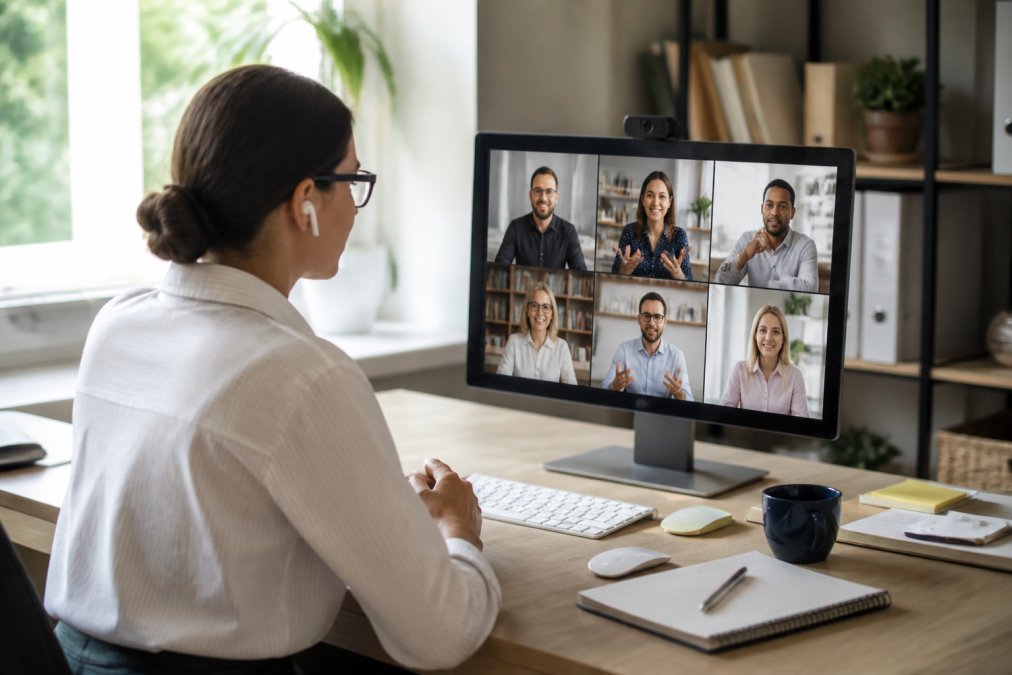
Successful hybrid team building rests on three foundations: intentional design, technical reliability, and genuine inclusion.
Intentional design means every activity has a clear purpose. Is it building cross-location relationships? Developing communication skills? Creating shared understanding? The best activities do multiple things at once.
Technical reliability matters more than you'd think. Test everything beforehand. Have a backup plan. Use platforms your team already knows.
Genuine inclusion means designing so remote and on-site staff have equal access and contribution. If an activity requires physical proximity or puts remote workers in a "watching" role, it's not truly hybrid.
Timing: Most games work best in 45-60 minute blocks. Build in five minutes at the start for tech checks and five minutes at the end for wrap-up.
Group size: Break larger teams into groups of 8-10 people, run the same game simultaneously in breakout rooms, then bring everyone together for a final debrief.
Facilitation: A good facilitator keeps energy up, includes quiet participants, and manages time. If using an external provider, ensure they understand your team's dynamics.
Instructions: Give clear instructions upfront. Write them down and share them in chat so people can reference them.
Debrief: Spend 10-15 minutes after the game asking: What surprised you? What did you learn about your teammates? How did this feel different from your normal working interactions?
Short activities (5-15 minutes): Ice-breakers and quick energisers work at the start of meetings without disrupting workflow.
Medium activities (30-60 minutes): Most team building games, trivia competitions, and problem-solving challenges. This is the sweet spot, long enough to build momentum but short enough that people stay engaged.
Extended activities (90 minutes to half-day): Workshops, creative projects, and immersive experiences. Reserve these for quarterly or annual events.
Full-day or multi-day events: Off-site retreats and intensive workshops. Appropriate for significant milestones, mergers, restructuring, or annual planning.
For hybrid teams, keep regular activities in the 30-60 minute range.
Accessibility is a design requirement, not an afterthought. Activities shouldn't assume everyone can stand, move quickly, or perform certain movements. A scavenger hunt works because people hunt from their own space.
Consider neurodiversity: high-energy, unstructured activities can overwhelm people with ADHD or autism. Some people process information better in writing than verbally. Design flexibility in and offer options.
Consider introversion: not everyone recharges through group interaction. Asynchronous activities and smaller group formats work better for introverts than large-group energisers.
Consider language: if your team includes non-native English speakers, avoid idioms, speak clearly, and provide written materials.
The best hybrid team building activities assume diversity in how people think, work, and engage.
Track these metrics before and after your team building programme:
Team cohesion: Survey your team on statements like "I trust my colleagues" and "I feel connected to people outside my immediate team." Run the survey before your first activity and again after three months.
Cross-location collaboration: Measure the number of projects involving mixed-location teams, collaboration quality, and decision-making speed across locations.
Retention and engagement: Track voluntary turnover and engagement scores. Team connection is one of the top reasons people stay in roles.
Communication quality: Ask managers whether they've noticed changes in how their teams communicate. Are there fewer misunderstandings? Is feedback more direct?
Participation rates: Track who's actually participating. If the same people show up and the same people decline, adjust your approach.
Team building is an investment in culture that pays off over quarters and years, not weeks.
Building genuine connection across hybrid teams requires intentional design, consistent facilitation, and honest measurement of what's actually improving.
Team Building Solutions specialises in designing hybrid team building programmes that move beyond one-off events to sustained culture change. With over 30 years of experience managing teams of five to 500 people, we understand the specific challenges of mixed-location collaboration. Our comprehensive account management handles everything from activity design to venue finding to post-event measurement, so you can focus on what actually matters: your team's connection and performance.
Ready to transform how your team works together across locations? Book a consultation with Team Building Solutions or Contact our team directly to discuss your specific needs.
The key is choosing activities that feel relevant to how your team actually works. Avoid trust falls and outdated icebreakers. Instead, focus on problem-solving challenges, games that require genuine collaboration, and activities that celebrate your team's mixed working patterns rather than ignoring them. Personalised facilitation matters too, experienced facilitators can read the room and adjust energy levels so nobody feels pressured or excluded. Team Building Solutions specialises in designing bespoke activities that feel natural to your team's culture.
Virtual ice-breaker games, asynchronous knowledge-sharing sessions, and five-minute energiser activities cost very little to run. Personality assessment workshops can be facilitated using free tools. Cross-location scavenger hunts using items people already have at home or in the office require minimal budget. The real cost is time and facilitation, having someone experienced guide the activity makes a massive difference to engagement, regardless of whether it's a paid facilitator or an internal champion trained to run it effectively.
Most organisations benefit from structured team building quarterly or twice yearly, depending on team size and restructuring activity. However, team cohesion also improves with regular micro-interactions, virtual coffee breaks, quick five-minute energisers, and informal knowledge-sharing sessions between larger events. The rhythm matters more than the frequency; consistent touchpoints build stronger relationships than sporadic big events. If your team is newly merged or under restructuring, more frequent check-ins help rebuild trust faster.
Yes, but only if the activities are designed specifically for that challenge. Generic icebreakers won't bridge departmental silos. Effective approaches include cross-departmental problem-solving challenges, facilitated communication exercises, and collaborative projects where people from different teams must work together toward a shared goal. Real-time synchronous activities that require active listening and genuine collaboration work better than asynchronous options for rebuilding team dynamics. Professional facilitation is essential when there's genuine tension.
Ensure all activities have a genuine virtual component, not just remote workers watching on-site teams. Use tools that let everyone participate equally, whether they're in the office or at home. Consider neurodivergent and introverted team members by offering quieter participation options alongside high-energy activities. Check accessibility needs in advance: mobility issues, hearing or sight considerations, and time zone challenges. The best hybrid activities feel designed for mixed working, not like on-site events with a Zoom link added as an afterthought.