



21 August 2026
Last Updated: August 21, 2026
Most team building events are designed with the same assumption: louder is better, bigger groups are more fun, and the best moments happen when everyone's participating at once. For roughly half your workforce, this approach feels like a personal nightmare.
Introverts aren't antisocial or unfriendly. They process information differently, recharge through quiet time, and often find high-energy group activities mentally exhausting rather than energising. When you design inclusive team building for introverts, you're not accommodating a quirk, you're acknowledging how different people actually work best.
The problem with traditional team building is that it treats introversion as something to overcome. Trust falls, rapid-fire icebreakers, and forced mingling put introverts in a position where they're either performing against their nature or sitting on the sidelines. Neither builds genuine connection or trust. In fact, research from the British Psychological Society on workplace wellbeing shows that employees forced into mismatched social environments report lower engagement and higher stress.
What gets missed is this: inclusive team building for introverts isn't a separate activity track. It's a different approach to how you structure interaction itself. When you build events around psychological safety, choice, and varied participation styles, introverts engage more authentically, and so does everyone else.
Inclusive team building for introverts isn't just the right thing to do ethically. It's a business decision that affects how your teams actually perform.
Teams with strong psychological safety, where people feel safe to contribute without fear of embarrassment or rejection, show measurably better collaboration and innovation. When introverts feel included, they contribute ideas they might otherwise keep quiet. According to Harvard Business Review's research on psychological safety, teams with high psychological safety are more likely to report errors, ask for help, and challenge the status quo constructively.
There's also a retention angle. Employees who feel their working style is respected stay longer and engage more deeply with their teams. Introverts who dread team building events often see them as a sign the organisation doesn't understand them. Conversely, when events are designed with their needs in mind, they feel genuinely valued.
The cost of poor team building is subtle but real. Forced activities create resentment rather than connection. People who hate the event don't suddenly feel closer to their colleagues, they feel more isolated. Inclusive team building for introverts flips this: it creates moments of genuine connection that transfer back to daily work.
Team Building Solutions has spent over 30 years designing events that work for different personality types.
The best activities for introverts share a common thread: they allow meaningful contribution without forcing performative extroversion. Low-pressure team building activities work because they replace the spotlight with structure.
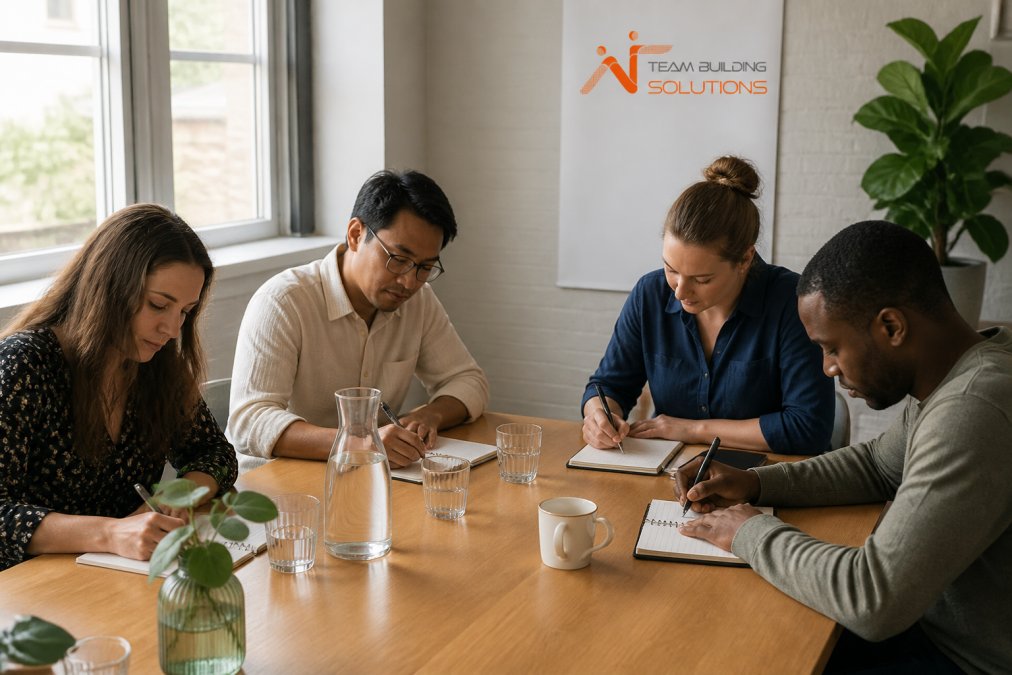
Written brainstorming removes the pressure to think on your feet in front of a group. Instead of calling out ideas in real time, participants write their thoughts individually, then the group builds on them together.
Here's how to structure it: Give the group a clear challenge or question. Set a timer for 10-15 minutes of silent individual brainstorming. Participants write down ideas on cards or sticky notes without discussion. Then, move to a group phase where ideas are shared, clustered, and discussed. The introvert has already contributed their best thinking before the group conversation starts.
This format works because it separates idea generation from group dynamics. Introverts often have strong ideas but need time to formulate them. By the time a traditional brainstorm reaches the discussion phase, they've already decided not to speak. Silent ideation flips the script: everyone contributes first, discussion happens second.
Rather than large group activities, structure collaboration in groups of three to five. Small group dynamics are fundamentally different from large ones. People speak more, listen more, and feel less anonymous pressure.
Pair introverts with colleagues they work with regularly, or mix teams intentionally around shared projects rather than random selection. The goal is to create conversation partners rather than an audience. When someone's talking to one or two people about something relevant to their work, participation feels natural rather than forced.
Small group activities also allow for varied participation styles. One person might lead the discussion. Another might take detailed notes. A third might ask clarifying questions. Everyone contributes meaningfully without needing to be the loudest voice in the room.
Build quiet time into the event schedule. Not break time where people check their phones, actual structured reflection time.
After a group activity or discussion, give people 10-15 minutes to sit quietly with a prompt. They might journal about what they learned, sketch ideas, or simply process what just happened. This serves two purposes: it gives introverts' brains a chance to recharge, and it deepens the work by creating space for genuine thought rather than constant activity.
Reflection time also surfaces insights that wouldn't emerge in group discussion. People often have their best thinking during quiet moments, not during the activity itself. By building this in, you're not just accommodating introversion, you're improving the quality of the work.
The word "icebreaker" makes many introverts cringe. The classic format, stand up, tell everyone something about yourself, hope you don't say something awkward, is a recipe for anxiety rather than connection.
Introvert-friendly icebreakers work because they remove the spotlight and create structured conversation. Instead of "tell us about yourself," try: "Write down three things you've learned this year. Turn to the person next to you and share one. They'll share one of theirs." Now you have a conversation starter that's bounded and reciprocal rather than a performance.
Another approach: pair people up and give them a specific question to discuss for five minutes. Then, each person introduces their partner to the larger group by sharing one thing they learned about them. This removes the pressure of self-promotion and creates a natural narrative structure.
The key is removing ambiguity and the spotlight. Icebreakers work when people know exactly what's expected, how long it will take, and that they're not being evaluated on how entertaining they are. Structure beats spontaneity for introverts.
Designing truly inclusive team building for introverts requires thinking beyond individual activities. It's about how the entire event is structured, from the moment people arrive to how you follow up afterward.
Psychological safety is the foundation of everything. It's the belief that you can take interpersonal risks, speak up, ask a question, admit you don't know something, without fear of embarrassment or negative consequences (peer-reviewed research).
Start by setting clear expectations. Tell people upfront what the event will include and what it won't. If there's no forced karaoke, say so. If people can opt out of certain activities, be explicit about that. Uncertainty creates anxiety; clarity creates safety.
Then, model the behaviour you want. Leaders and facilitators should be the first to be vulnerable. Share something genuine about yourself. Admit when you don't have an answer. Show that it's safe to be authentic rather than polished.
Physical environment matters too. Ensure there are quiet spaces where people can take breaks. Don't fill every moment with scheduled activity. Build in buffer time. Some of the best team conversations happen in the margins, not during the formal activities.
Not everyone needs the same thing to feel included. Some people thrive in one-on-one conversations. Others prefer working on a task together. Some want to observe before participating. All of these are valid.
Design activities with multiple entry points. If you're doing a group discussion, also have a written component. If you're doing a physical activity, offer a non-physical alternative. If you're doing something social, also build in time to work on something meaningful.
This isn't about having separate activities for introverts and extroverts. It's about designing each activity so it works for different participation styles. Written input, small group discussion, and independent work aren't "introvert activities", they're just better activities, period.
Schedule breaks explicitly. Don't assume people will take them. Put them on the agenda. "2:00-2:30 PM: Break" gives everyone permission to step away without feeling like they're missing something.
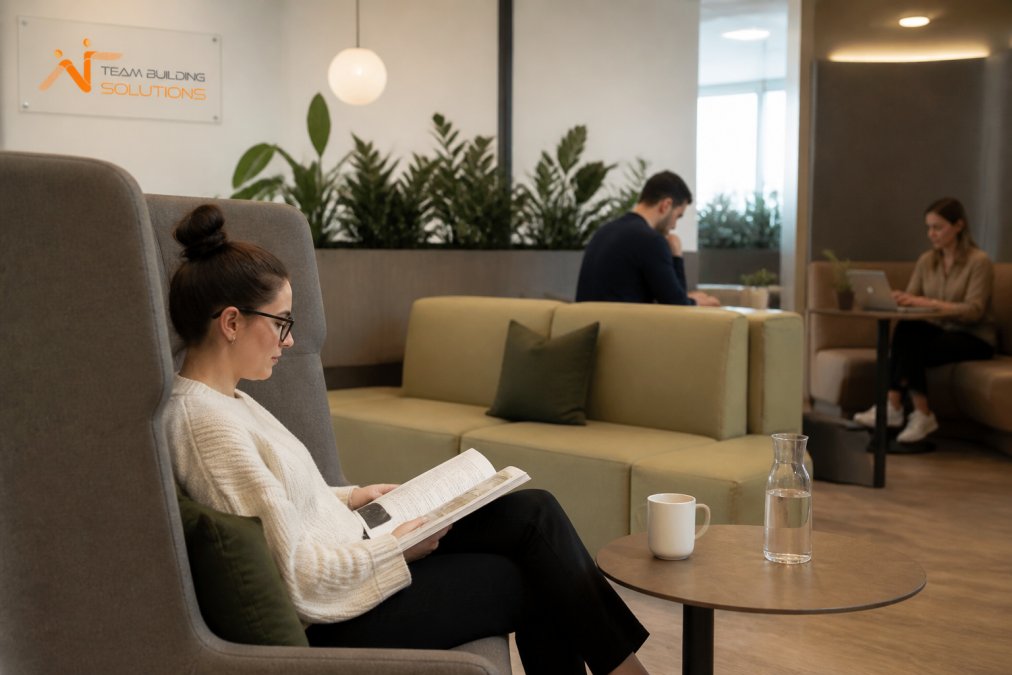
Create actual break spaces, quiet rooms where people can sit without being watched or interrupted. Some people will use this time to recharge. Others will use it to have one-on-one conversations. Both are valuable.
The introvert who needs 20 minutes of quiet to recharge isn't being antisocial. They're preparing to engage more fully in the next activity. By building this into the schedule, you're not accommodating a weakness, you're enabling better participation.
Most organisations measure team building success by attendance or immediate feedback ("Did you have fun?"). That's not enough. Real success shows up weeks later in how teams actually work together.
Post-event feedback should ask specific questions: Did you feel heard in discussions? Did you learn something new about your colleagues? Would you recommend this type of event again? These questions reveal whether the event actually built connection and psychological safety, not just whether people enjoyed themselves.
Neurodiversity integration means recognising that people process information and interact in different ways. Some people are introverts. Some are neurodivergent (ADHD, autism, dyslexia). Some are both. Some people have social anxiety. Some people are highly sensitive to stimulation.
Inclusive team building for introverts is really about neurodiversity-informed design. It means offering choices, providing structure, allowing different participation styles, and building in sensory breaks. When you design for neurodiversity, you're designing for everyone.
Follow up with participants individually. Ask what worked and what didn't. Ask what they'd change. This feedback loop shows that you're genuinely committed to inclusion, not just going through the motions.
Team Building Solutions uses comprehensive post-event evaluation to understand what actually moved the needle for your team. This data-driven approach helps refine future events so they work better for everyone.
| Activity Type | Best For | Key Benefit | Introvert Comfort Level |
|---|---|---|---|
| Written brainstorming | Generating diverse ideas | Everyone contributes before discussion | High |
| Small group collaboration | Building relationships | Conversation feels natural | High |
| Structured reflection | Processing and learning | Quiet time built in | High |
| One-on-one icebreakers | Initial connection | Bounded, reciprocal conversation | High |
| Quiet break spaces | Recharging energy | Permission to step away | High |
Inclusive team building for introverts isn't a special accommodation. It's better event design, full stop. When you build events around psychological safety, structured participation, and respect for different working styles, everyone engages more authentically.
The shift from forcing extroversion to enabling genuine connection changes what team building actually accomplishes. Instead of creating memories of awkward moments, you're building real trust. Instead of leaving introverts drained, you're leaving them energised and more connected to their colleagues.
If you're planning a team building event and want to ensure it works for everyone on your team, including the introverts who often get left out, Team Building Solutions can help. With over 30 years of experience designing inclusive corporate events for groups of 5 to 500, we specialise in creating experiences where different personality types actually want to participate. From award-winning wellness sessions to bespoke collaborative workshops, we handle the full scope of event planning, including our free venue finding service, so every detail supports genuine connection. Contact Team Building Solutions to discuss how we can design an event that works for your entire team, or book a consultation to explore options that fit your specific needs and culture.
A: Effective inclusive team building for introverts focuses on meaningful connection rather than high-energy spectacle. Written brainstorming, small group discussions, peer mentoring, and structured reflection time allow introverts to contribute authentically. Activities that pair people one-on-one or in groups of three often feel less intimidating than large group games. The key is offering choice: let people opt into activities that suit their working style, and always provide quiet spaces where employees can recharge between sessions.
A: The best introvert-friendly icebreakers remove the pressure of spontaneous public speaking. Written exercises (where people write answers before sharing), small group rotations instead of whole-room introductions, and paired conversations allow introverts to prepare their thoughts. Ask open-ended questions that people can answer in writing first, then discuss in pairs. Avoid rapid-fire games, spotlight moments, or activities that require people to share personal stories without warning. Offering multiple ways to participate, verbal, written, or observational, ensures everyone can engage at their comfort level.
A: Psychological safety in team building means people trust they won't be embarrassed, excluded, or forced into uncomfortable situations. This starts before the event: communicate the agenda clearly, explain why activities matter, and explicitly say participation is flexible. During the event, model active listening, avoid mandatory sharing, and never single people out. Create designated quiet spaces where people can step away without explanation. After the event, gather feedback specifically about comfort and inclusion, and adjust future events based on what you learn. Team Building Solutions uses this approach to ensure every attendee, regardless of personality type, feels valued.
A: The most effective approach is to design inclusive events from the start rather than adding accommodations later. Structure activities so that quiet contribution is the default: small group work, written input, and individual reflection time benefit everyone, not just introverts. Offer genuine choice in how people participate, some might join a group activity, others might contribute ideas in writing or through one-on-one conversations. Train managers to recognise that deep listening and thoughtful input are forms of participation and leadership. When inclusion is built into the event design, no one stands out as needing special treatment.