


26 August 2026
Last Updated: August 26, 2026
Remote work has fundamentally changed how teams connect. When your workforce is distributed across multiple locations and time zones, traditional office interactions disappear. Online team games for work create structured moments of genuine interaction that counteract isolation.

According to research on remote workforce engagement, teams that participate in structured collaborative activities report higher engagement scores and stronger cross-functional relationships. Team Building Solutions has spent over 30 years designing events that build genuine connection. Online team games for work aren't about entertainment for its own sake, they're about creating moments where distributed teams can actually interact as humans.
Icebreaker activities lower the activation energy required for participation. Two Truths and a Lie works particularly well because it requires minimal technical setup. Participants share three statements about themselves, and others guess which is false, surfacing genuine personality details that colleagues often never learn about each other (peer-reviewed research). Execution takes 15-20 minutes for groups up to 20 people.
Speed Networking adapted for video calls creates structured one-on-one interactions. Participants are paired randomly for 3-minute conversations, then rotate to new pairings. Over 20-30 minutes, each person has meaningful individual contact with multiple colleagues.
Telephone adapted for digital channels highlights how easily messages get distorted. One person describes an image, the next person draws based on that description, and so on. By the final round, the result bears little resemblance to the original. It takes 20-30 minutes and works for groups of 8-20.
Escape room challenges require genuine collaboration. Teams receive a scenario and must solve puzzles by working together, sharing information, and building on each other's insights. Online platforms host these experiences with facilitation included. Groups typically spend 45-60 minutes on a single challenge.
Picture Pieces requires teams to reconstruct an image using only written descriptions. One team member sees the image and describes it; others must draw based solely on that description. This exercise exposes how people explain visual information and how well others interpret instructions. It typically runs 25-35 minutes for groups of 10-30.
Trivia games tap into existing knowledge whilst creating friendly competition. General knowledge trivia works best when you mix categories, film, history, science, sport, geography, so different expertise surfaces. Running rounds of 5-10 questions with team scoring creates collective investment. A typical session runs 30-45 minutes.
Custom company trivia focuses on internal knowledge: company history, team achievements, product details, or departmental facts. This reinforces organisational culture and makes newer employees feel included as they learn company specifics.
Pictionary adapted for digital platforms requires participants to draw on a shared canvas whilst others guess. Most platforms include drawing tools built in. The activity typically runs 30-45 minutes and works for groups of 5-30.
Collaborative storytelling has one person start a narrative with a single sentence, the next person adds a sentence, and so on. The results are invariably absurd and often hilarious. A complete story typically takes 15-20 minutes to build.
Logic puzzles presented to the full group create collaborative problem-solving. One person reads the puzzle whilst others contribute ideas. The activity surfaces how teams approach problems and handle disagreement. A single complex puzzle typically takes 30-45 minutes.
Escape room experiences delivered by professional facilitators create high-stakes collaboration. Teams must solve puzzles, decode messages, and work through challenges within a time limit. Most experiences run 45-60 minutes and accommodate groups of 4-8 per team.
Quick-fire icebreakers (5-10 minutes) work well at the start of regular meetings. Rapid-fire questions like "What's your hidden talent?" surface personality whilst keeping meetings on schedule.
Word association games run in chat during meetings, with participants building chains of associated words. They require minimal attention and work well as a parallel activity during longer meetings.
One-minute challenges ask participants to complete a task in 60 seconds, draw something, list items in a category, or solve a simple puzzle. These create quick moments of engagement without derailing meeting agendas.
The most significant oversight in remote team building is designing activities that exclude people with disabilities, neurodivergence, or different working styles. Offering multiple participation modes matters more in virtual settings. If an activity requires real-time verbal contribution, provide a text-based alternative. If it requires drawing, offer description-based alternatives. Explicitly stating that people can participate in whatever way feels comfortable removes pressure that prevents genuine engagement.
For truly distributed teams, asynchronous versions of games allow participation without asking people to join at unreasonable hours. A prompt is posted, team members respond over 24-48 hours, and results are compiled. Two Truths and a Lie, picture description games, and creative writing challenges all work asynchronously.
Debriefing transforms a game from entertainment into a genuine team development tool. Structured reflection after games surfaces insights about team dynamics. Simple questions like "What did you notice about how we communicated?" prompt people to reflect on process rather than just outcome.
Connecting game observations to work patterns makes the activity relevant. If an escape room revealed that certain people dominate conversations whilst others stay quiet, that observation directly applies to how the team functions in meetings. Celebrating effort and vulnerability matters more than celebrating winning.
Platforms designed specifically for virtual team building include built-in games, breakout room functionality, and engagement features. Video conferencing platforms (Zoom, Microsoft Teams, Google Meet) can host most games using built-in features like breakout rooms, polls, chat, and screen sharing. Collaborative document platforms (Google Docs, Microsoft 365) enable asynchronous games and provide shared spaces for team creation.
The choice depends on group size, technical comfort, and whether you need synchronous or asynchronous functionality. Most organisations benefit from combining tools.
The optimal game choice shifts dramatically based on group size. What works brilliantly for 8 people becomes chaotic with 80.
| Game Type | Small Teams (5-15) | Medium Teams (16-40) | Large Teams (40+) |
|---|---|---|---|
| Two Truths and a Lie | Excellent, everyone participates fully | Good, works with breakout rooms | Poor, limited participation time |
| Escape Rooms | Excellent, high engagement, manageable complexity | Good, multiple teams competing | Poor, too many people per team |
| Trivia | Good, everyone can answer | Excellent, team competition works well | Excellent, breakout team format |
| Pictionary | Excellent, everyone draws and guesses | Good, rotate participants | Fair, long waits for turns |
| Speed Networking | Fair, limited pairing options | Excellent, creates many connections | Excellent, systematic rotation |
| Storytelling | Excellent, intimate and creative | Good, maintain energy across rounds | Poor, loses cohesion with size |
| Scavenger Hunts | Good, manageable scope | Excellent, team competition | Excellent, parallel team execution |
| Breakout Challenges | Fair, limited complexity | Excellent, multiple team scenarios | Excellent, multiple simultaneous teams |
Small teams allow deeper interaction and more intimate activities. Medium teams benefit from competitive structures and breakout room functionality. Large teams require activities that work in parallel to prevent the experience becoming a passive spectacle where most people watch rather than participate.
Team Building Solutions has facilitated events for groups ranging from 5 to 500 people. We understand that the same activity that creates magic for a small team becomes unwieldy at scale. Our approach matches game selection to group size, ensuring everyone actively participates.
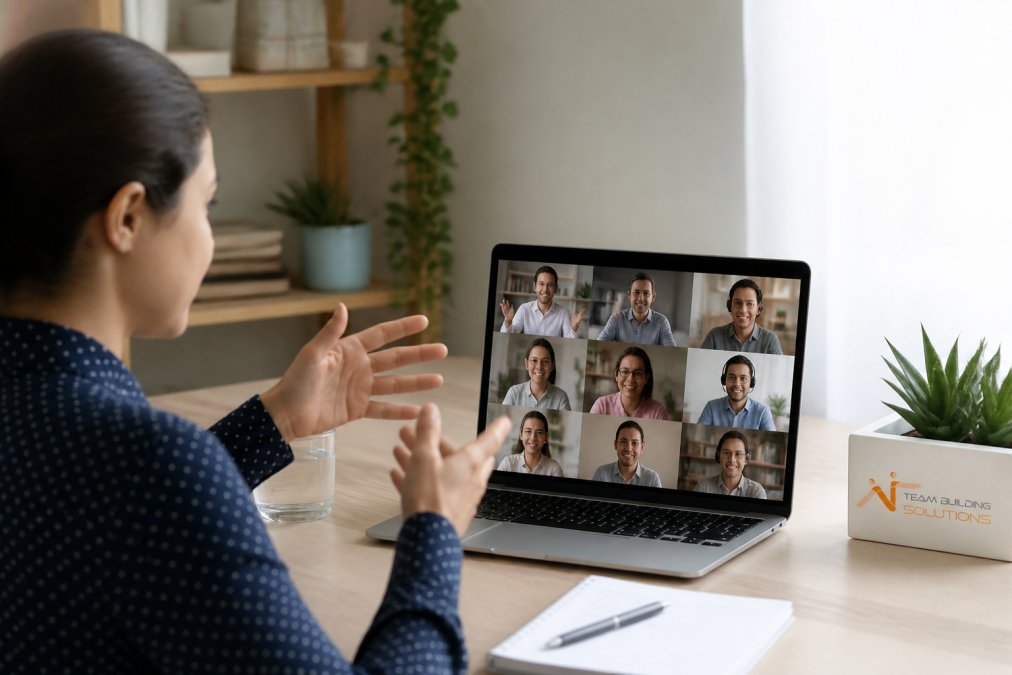
Facilitation quality determines whether an activity becomes a genuine team-building moment or an awkward obligation.
Set clear expectations before starting. Explain what the activity is, how long it will take, what participation looks like, and that participation is optional. Explicitly state that people can participate in whatever way feels comfortable.
Create psychological safety. If you demonstrate willingness to be vulnerable, make mistakes, and laugh at yourself, participants relax. Share something personal early to set the tone.
Manage energy and pacing. Virtual fatigue is real (apa.org). Build in breaks, vary activity intensity, and watch for signs of disengagement. Shorter, well-paced activities beat longer ones that overstay their welcome.
Facilitate inclusivity actively. Actively invite quieter team members to contribute. Offer multiple participation modes and watch for people being left out.
Manage technical issues gracefully. Someone's connection will drop. Treat these as normal rather than problems and move forward with humour.
Debrief and connect to work. Take 5-10 minutes after the activity to discuss what happened, what people noticed, and how observations apply to how the team works together.
Games that require active listening, clear instructions, and real-time interaction work best for remote communication. Icebreaker activities break down barriers between team members, whilst collaborative problem-solving games like escape room challenges force synchronous communication and creative thinking. Quiz-based trivia encourages participation across the whole group and creates natural opportunities for informal chat. The most effective options combine structured gameplay with built-in moments for team members to explain their thinking, ask questions, and celebrate wins together.
Brief games (10-15 minutes) combat meeting fatigue by introducing interactive elements that break up passive listening. They boost participation rates by giving quieter team members low-pressure ways to contribute, and they create positive associations with work interactions. Games also reduce communication barriers by shifting focus from formal hierarchy to shared challenge or fun. When designed with inclusivity in mind, they help distributed teams feel connected without requiring lengthy time commitments that strain work-life balance.
Reliable video conferencing platforms with breakout room functionality are foundational. You'll also want tools that support screen sharing, polling, and real-time collaboration (whiteboards, shared documents). Dedicated team building platforms can streamline game facilitation and scoring. Choose tools that integrate with your existing tech stack to reduce friction and learning curves. Accessibility features like captions, adjustable text sizes, and keyboard navigation should be non-negotiable. Team Building Solutions offers comprehensive support in selecting and integrating the right tools for your specific group size and meeting format.
Yes. Structured games create neutral ground where people from different departments interact based on shared objectives rather than old team boundaries. Escape room challenges and collaborative problem-solving activities naturally build cross-functional rapport. Icebreakers help new team members learn names and find common ground quickly. However, surface-level games alone won't resolve genuine tension. The most effective approach pairs games with skilled facilitation and post-game debriefing that acknowledges real concerns and builds psychological safety. Team Building Solutions specialises in designing bespoke activities tailored to your specific team dynamics and challenges.
Absolutely. Asynchronous options allow participation without real-time pressure. Chat-based trivia, collaborative drawing games where participants can contribute at their own pace, and written problem-solving activities work well for introverts. For mobility considerations, ensure all games are playable from a seated position without requiring physical movement or standing. Avoid games requiring camera-on participation if that creates discomfort. Quiz and creative games often suit diverse abilities better than high-energy activities. Proper facilitation means explicitly stating that participation methods can vary (camera off, audio only, chat-based responses) without penalty.